|
Axelerant
|
|
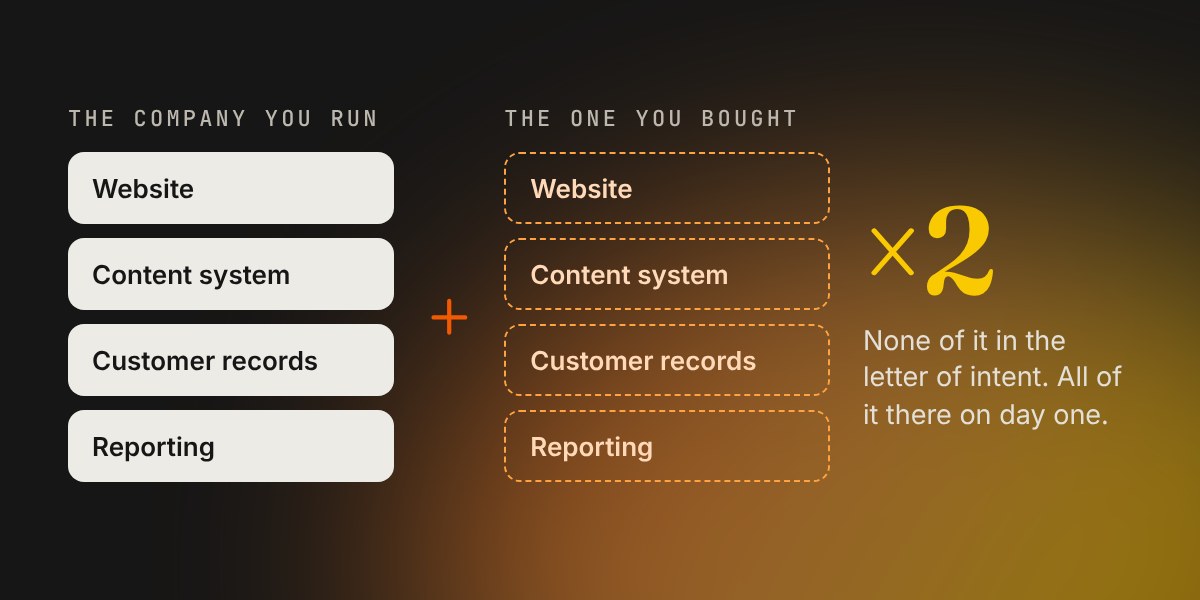
An acquisition buys you a company. It also buys you a second set of everything.
|
|
The Axelerant newsletter · October 2026
|
|
|
| |
|
|
|
This edition is about what happens to the digital estate after a deal closes. It is the work we have spent most of this year on, it is where we spent two days in Philadelphia on October 20 and 21, and it is the question we get asked more than any other right now: we bought the companies, what do we run them on?
|
01 The part the deal model misses
Revenue and headcount get counted. The estate does not.
Every company you acquire arrives with another website on another platform, another content system, another set of customer records, and another set of reporting definitions. None of it appears in the letter of intent. All of it arrives on day one.
It usually gets treated as an IT matter, handled after close, by people who were not in the deal. That framing is the expensive part. It moves a priceable cost into the one period when nobody is looking for it.
|
02 What it costs
Three effects, and they compound
|
The synergy becomes unverifiable. Cross-sell needs one view of the customer. If that customer exists twice, in two systems, with two spellings, the cross-sell is either happening and invisible or not happening at all. Nobody can tell the board which.
|
| |
|
The integration cost was already there. A failed implementation inside the company you bought is a liability you inherit at close. It is discoverable during diligence, and almost nobody looks for it.
|
| |
|
It repeats on every deal. If nothing exists for absorbing a company, the next acquisition pays the same bill again, improvised by the same people, who are now also maintaining the last one.
|
And it surfaces again at your own exit, when a buyer's quality-of-earnings process finds the definitional inconsistencies nobody reconciled. One business counting a deal at proposal and another at signature stops being a quirk in that room.
|
03 From the floor at M&A East
Two days in Philadelphia asking the same question
Sachin spent Oct 20 and 21 at ACG's M&A East, mostly with operating partners, corporate development teams and the people who run platforms built by acquisition. One question, asked repeatedly: you bought the companies, what are you running them on?
We did our homework before the flight. From the attendee list we picked 16 companies that grow by buying other companies, then looked at 26 of their brand websites from the outside. Four already had HubSpot somewhere inside. One ran four different web platforms across its brands, and one of those sites was returning a server error on the day we checked.
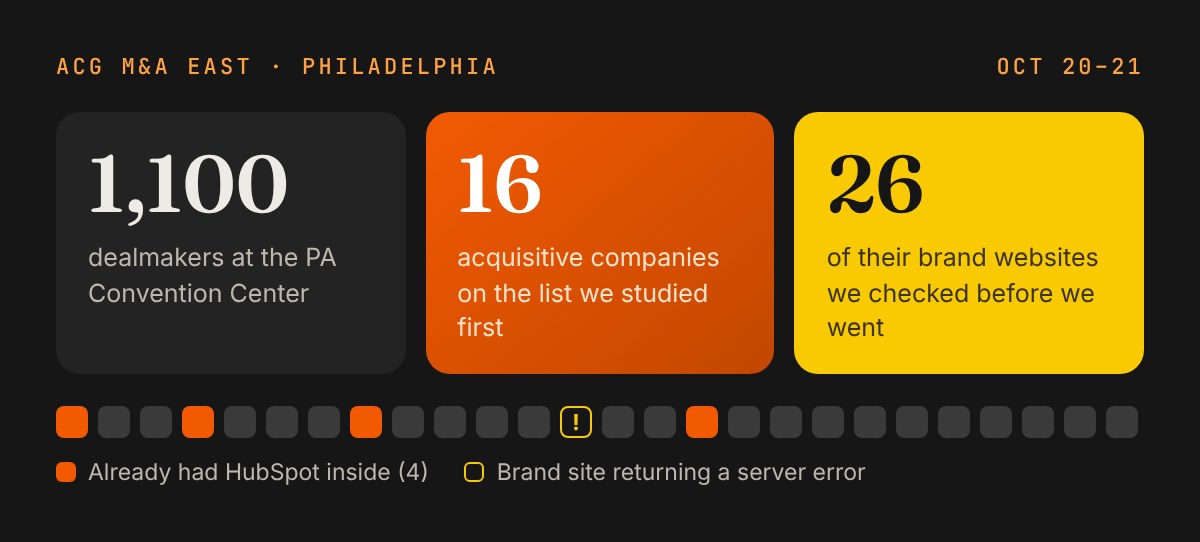
That is the second set of everything, visible from a browser before anyone signs an NDA. It also sharpened who we want to talk to: less the largest funds, more the mid-sized companies that pick up a new CRM after they are acquired, while the estate decision is still open.
|
|
04 How we approach it
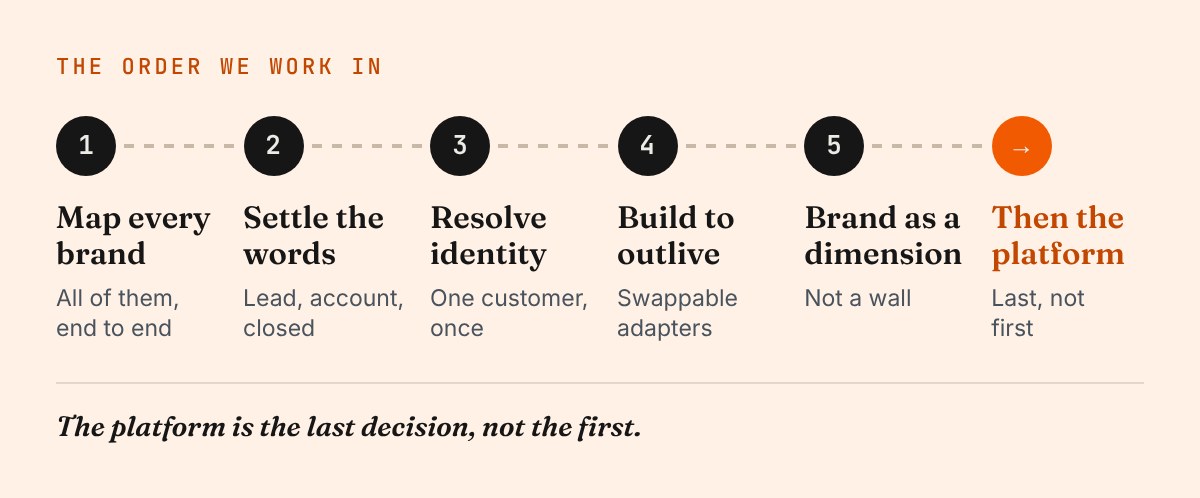
The platform is the last decision, not the first
|
Map every brand before drawing any future state. A target architecture that fits the largest business will not survive the other three arriving. We map them all end to end first.
|
|
Settle vocabulary before architecture. One company says lead, the other says account. An integration faithfully transmits whatever confusion already exists, and in a group it amplifies it, because the definitions now collide inside one report.
|
|
Resolve identity before building on top of it. Automation running on unresolved duplicates does not fail loudly. It produces confident, wrong answers faster than a person could.
|
|
Build the integration to outlive the systems. Where a platform change is genuinely plausible, we treat the operational side as a replaceable adapter rather than a permanent assumption.
|
|
Keep brand as a dimension, not a wall. Separate instances per brand are tidy and recreate the exact problem you are solving. One environment, brand as a structural dimension, customer record stays single.
|
|
05 The honest part
The second attempt is the one that matters
Most groups we meet have already tried once. The pattern is consistent: the data sync failed, duplicates multiplied with no agreed way to resolve them, nobody was clear who owned which process, and eventually people stopped trusting what the system told them and went back to the spreadsheet.
Three of those are engineering problems. The fourth is not. Trust is not recoverable by shipping a fix, which is why a second attempt is a different project from the first, and why it gets judged on whether the numbers survive the first hard question in a leadership meeting.
|
|
06 If this is your situation
We will read your estate from the outside
If your group has grown by acquisition and you are working out what the acquired companies should run on, we are glad to look at the estate and tell you what we see. Twenty minutes, no pitch, and you keep whatever we work out. Reply to this email and a human reads it.
|
Worth a read
|
Digital fragmentation is the cost sitting inside every target that diligence never checks
The seven layers an acquisition duplicates, what each one costs when left alone, and seven questions worth asking about a target's estate before you sign. None of them need a technologist to ask.
Read the piece →
|
| |
|
Why most digital delivery fails before a single line of code is written
The same argument as section 04, from the delivery side. Every build decision quietly assumes someone owns the governance behind it. When nobody does, projects don't fail loudly. They stall, waiting for an owner who was never named.
Read the piece →
|
|
|
Axelerant
|
|
Intelligence that delivers.
|
|
You're receiving this because you work with Axelerant or asked to hear from us. Reply anytime; a human reads every response.
|
|
This is a preview build for internal review. Merge tags for company address, unsubscribe, and preference links are inserted in HubSpot before send.
|
|
|